Peptide Pureness Guide 98%, 99% & Research-grade Clarified Prg
It is an area-percent pureness dimension, not a total identity or task test. Notably, pureness percentages define chemical make-up only-- they do not suggest sterility or biological suitability. Discover more Peptides from Maxed Out Compounds are provided exclusively for research laboratory research study use and are not intended for human or veterinary objectives. Peptide pureness is typically revealed as a portion, such as 95% or 98%. This figure stands for how much of the example is made up of the wanted peptide sequence. For a lot of lab applications, a pureness of 95% or higher is thought about research-grade.- It divides the elements of an example based upon their differential fondness for a stationary phase (column packaging product) and a mobile stage (solvent system moving via the column).These evaluations are beneficial when clients need greater than a mass spectrum and chromatogram to judge whether a whole lot is truly fit for quantitative job.Because peptides are created through complex chemical procedures, trace contaminations can create normally.Peptide identification is primarily carried out utilizing mass spectrometry (MS), which supplies precise dimensions of peptide molecular weight.
Sorts Of Pollutants Hplc Finds
HPLC informs you what proportion of your sample is the major compound-- however it does not validate what that main substance actually is. A top with the right retention time can in theory be an associated peptide with comparable hydrophobicity. Mass spectrometry offers identity confirmation by measuring molecular mass directly. We assess peptide size, sequence composition, expected molecular weight, adjustment kind, salt type, example history, and designated downstream usage before defining the logical path.
If the COA lists "total contaminations", that matches the purity number (e.g., 98% pureness implies 2% total pollutants). Lots Lyophilized Peptide of COAs also specify recognized or "specified impurities" versus undefined ones, each with their specific portions if over a specific limit. This degree of detail helps researchers understand if any type of small peptide by-products exist. If you see multiple huge heights of comparable height, you're checking out either a low-purity sample or a blend. If the primary height has a visible "shoulder"-- a bump on one side-- that usually suggests a carefully relevant contamination (like a deletion peptide) that the column could not totally resolve. The peptide is travelled through an easy filtration step (frequently gel purification or a quick reversed-phase cleaning) to get rid of salts, small-molecule results, and scavengers from the bosom step.
Our Peptide Chemical & Physical Analysis Solutions
It is one reason appropriate peptide storage and reconstitution methods issue. Partial peptide pieces can arise from insufficient synthesis or post-synthesis deterioration. These pieces are usually smaller sized than the target peptide and may elute at various retention times.
An approved laboratory follows stringent guidelines for examination accuracy and technique recognition. You can frequently inspect if a lab is recognized via its website or paperwork; certification ensures the lab's methods and results are held to global requirements. With high degrees of experience in carbohydrate chemistry and our extensive peptide analysis system, Creative Peptides can give high-quality peptide purity determination services. According to strict evaluation quality assurance and biosynthetic quality control criteria, each peptide is strictly monitored during the analysis cycle.
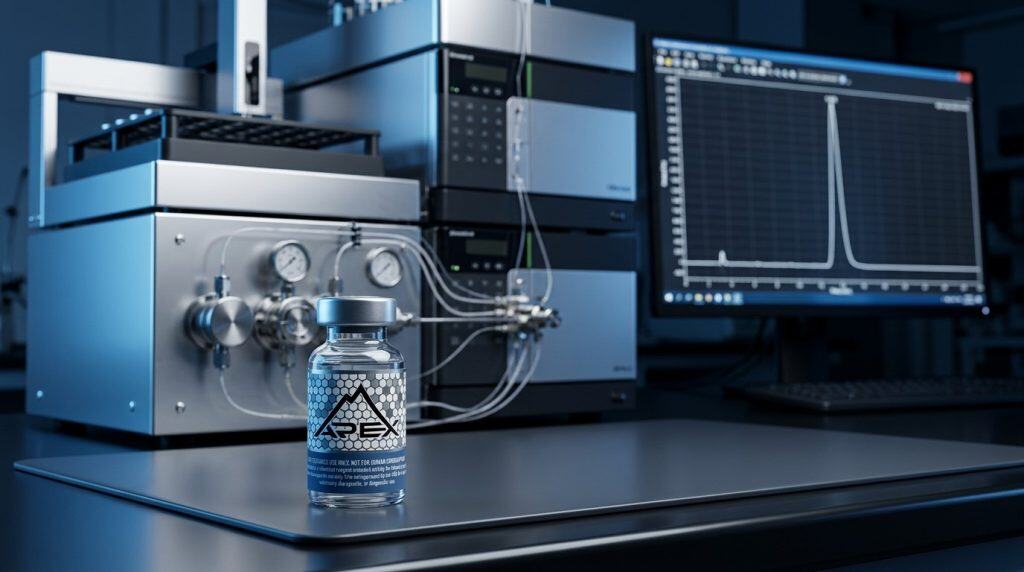
The gold requirement for determining peptide purity is high-performance liquid chromatography, widely abbreviated as HPLC. If you see a purity percent on a peptide item, it likely originated from an HPLC evaluation. This matters since peptides are built one amino acid each time with solid-phase peptide synthesis (SPPS). At each step, there's a tiny possibility that something goes wrong-- an amino acid does not attach, the incorrect alteration takes place, or a side response produces an unexpected result. Over a chain of 10, 20, or 40 amino acids, those small per-step error rates compound.
Nevertheless, achieving ultra-high pureness (say 99%) can be technically challenging and may not constantly be needed, as we'll talk about later on. The secret is understanding what degree of pureness suffices for your demands and how pureness is figured out in the first place. For many research study purposes, high purity means you can be certain that the substantial bulk of the particles in your vial are the proper peptide, which assists make sure speculative uniformity and reproducibility. Our workflow is developed to relocate from example context review to interpretable peptide information with marginal logical ambiguity. Projects can range from one sample identity check to multi-lot comparability, residual evaluation, solubility analysis, or stability-focused logical bundles. Hydrophobic peptides, extremely standard series, changed constructs, and very closely related analogs can be reviewed with approach modifications matched to their analytical dangers.